
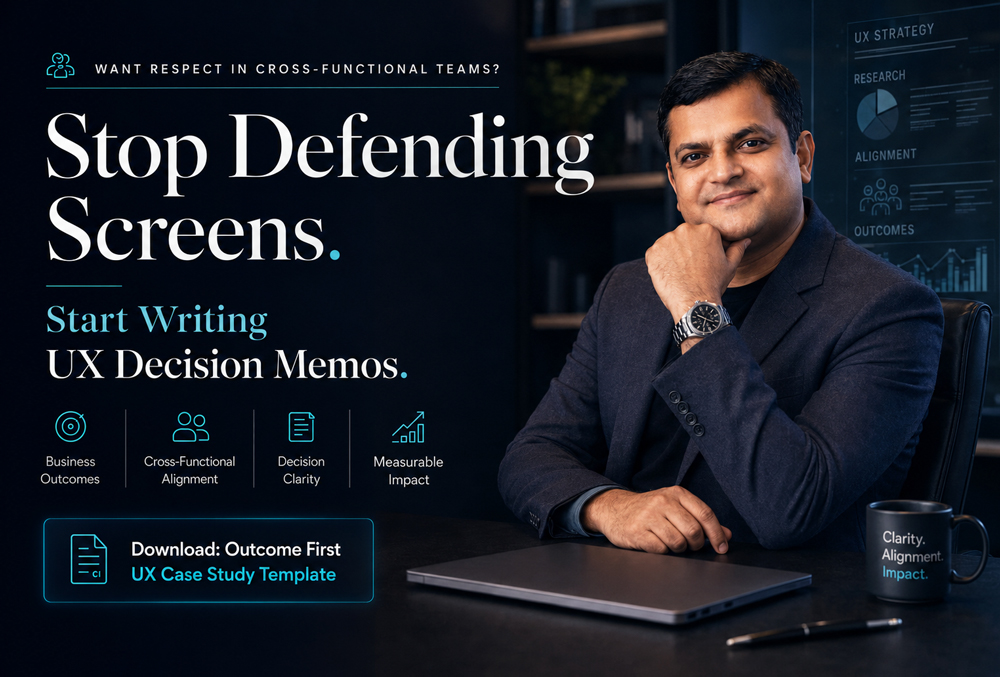
The Strategic UX Shift
If you want to command respect and secure a high-level ux job, stop presenting UI screens as your primary deliverable. Cross-functional teams do not care about decoration; they care about risk. Start writing UX Decision Memos—short, strategic documents that outline the business problem, evidence, trade-offs, and expected financial impact of your design choices. This is how you stop taking orders and start driving business strategy.
The Harsh Reality of Design Reviews
Most UX designers are not ignored by leadership because they lack talent. They are ignored because their strategic thinking is completely invisible.
I have spent over 25 years in this industry diagnosing complex friction points, and I see the exact same mistake every day. A designer walks into a room with Product, Engineering, and Sales. They put a Figma prototype on the screen. They start defending their layout, explaining their spacing, and justifying their button colors.
Within minutes, the room tears the design apart. Product asks about conversion. Engineering complains about tech debt.
This happens because cross-functional teams do not respect decoration. They respect decisions that reduce business risk. If you are a senior designer stuck at the same level, constantly wondering why you are an experienced ux no job offer candidate, I will give you the unfiltered truth:
Your case studies lack outcomes and accountability.
You have polished screens. You have 5+ years of experience. But if your work does not clearly articulate the business problem, the strategic trade-offs, and the measurable impact, executives simply see you as a pixel-pusher.
The Respect Problem: Teams Speak Risk, You Speak Design
Every department in a cross-functional team is protecting a specific type of risk.
- Product protects roadmap risk.
- Engineering protects delivery risk.
- Sales protects buyer confidence.
- Support protects operational load.
- Leadership protects revenue.
When you only talk about “clean UI” and “usability heuristics,” you sound narrow. To become commercially relevant, you must connect your usability findings directly to conversion, retention, and trust.
Weak UX Argument: “We should shorten the form because users prefer simple flows.” Executive UX Argument: “Asking for high-commitment data before establishing trust is reducing our qualified lead submissions. Moving the phone number field to post-intent confirmation limits upfront sales data, but our expected impact is a 15% drop in form abandonment.”
You are no longer asking for approval on a screen. You are presenting a business decision.
What is a UX Decision Memo?
A UX decision memo is a concise, written document that explains the exact rationale behind a design choice. It is not a massive 20-page research report. It is a highly skimmable, business-facing argument.
Here is the exact framework we use at UXGen Studio to align stakeholders and drive conversion rate optimization (CRO):
1. Diagnosed Friction (The Real Problem)
Do not start with “the UI looks outdated.” Start with the bleeding neck. Example: “Our mobile onboarding completion rate is dropping at step three. Users are hitting the pricing tier screen but abandoning the flow before selecting a plan.”
2. The Evidence (Data > Opinions)
What proves this is actually happening? Example: “Session recordings and heatmaps show high cursor hesitation around the feature comparison list. Support tickets indicate users are confused about what the premium tier actually includes.”
3. The UX Decision
What is your strategic recommendation? Example: “We are restructuring the pricing hierarchy. We will move the trust-proof outcomes and the simplified plan comparison table above the primary CTA.”
4. The Trade-Off Evaluated
Show leadership you weighed the options. What are you sacrificing? Example: “This decision pushes the secondary FAQ section below the fold, which slightly increases scroll depth. However, it resolves core pricing anxiety exactly when the user is making a buying decision.”
5. The Risk
What could go wrong, and how will you handle it? Example: “If the new comparison table is too dense, mobile users might feel overwhelmed. We will mitigate this by launching a simplified accordion view first.”
6. Expected Business Impact
Tie it to the bottom line. Example: “We project a reduction in pricing hesitation, leading to a 4-6% increase in premium plan selections.”
Breaking the “Experienced UX No Job Offer” Cycle
A strong UX portfolio is not a visual gallery; it is a ledger of your judgment.
When hiring managers and founders look at your work, they are silently asking if you can handle ambiguity, align with engineering, and connect your work to revenue. If your portfolio only shows wireframes, user personas, and high-fidelity screens, you look like an executor.
To break out of the rut, add a “UX Decision Memo” section to every project in your portfolio. Make your trade-offs visible. Again, the reason you are struggling is that your case studies lack outcomes and accountability. Proving that you understand business logic is the fastest way to command a premium salary.
How UXGen Academy Builds Strategic Leaders
The market has shifted. Knowing Figma components is the bare minimum. Knowing how to defend your work as a revenue driver is the premium skill.
At UXGen Academy, we don’t just teach software; we teach UX as a high-stakes, career-facing business discipline. As Mentor Manoj, I bring over 25 years of trench experience as a researcher, UX architect, and hiring leader directly into our curriculum.
Our AI Driven UX Mastery roadmap is built to solve this exact career plateau. We teach you how to use AI to rapidly synthesize research data, diagnose complex friction points, and structure your arguments so powerfully that leadership has no choice but to listen. I deploy my total experience to ensure you aren’t just learning theory—you are learning how to secure your next promotion, earn deep respect, and position yourself as an indispensable executive partner.
Start Leading the Room
The next time you walk into a cross-functional meeting, do not open your design file first. Open a document.
Say, “Before we look at the UI, I want to walk through the business decision behind this flow.” Watch the room change. Watch the feedback shift from random subjective opinions to strategic alignment.
Ready to upgrade your case studies and start proving your business impact? Download our exact framework to ensure your portfolio stops getting ignored by hiring managers.
👉 Download: Outcome First UX Case Study Template
DM: MASTERY to get access to this template and learn how our live training can transform your UX career trajectory.
Frequently Asked Questions (FAQs)
- What is a UX decision memo?
A UX decision memo is a short, strategic document that outlines the business problem, evidence, trade-offs, risk, and expected ROI of a specific design choice. It is used to align cross-functional teams before reviewing visual screens.
- Why do I keep getting rejected for senior UX roles?
If you are an experienced professional but getting no job offers, your portfolio likely focuses too heavily on visual outputs rather than business outcomes. Hiring panels want to see how your design decisions mitigated risk and drove metrics like conversion or retention.
- How do I prove business impact if my company doesn’t track metrics?
If you lack hard data, use qualitative evidence and heuristic evaluations. Document the observed friction (e.g., support ticket themes, sales objections, or user testing hesitation) and clearly state your expected impact. The goal is to prove you are thinking about the business, even if the analytics tracking is imperfect.
- How does a UX decision memo help with difficult stakeholders?
It shifts the conversation away from subjective opinions (like “I don’t like this color”) and grounds the discussion in business logic. When you present the trade-offs and risks upfront, stakeholders view you as a strategic partner rather than an order-taker.
- Who is the AI Driven UX Mastery program for?
This program is designed by Mentor Manoj for mid-to-senior UX/UI designers who are stuck at their current level, struggling to gain leadership influence, or facing a tough job market. It teaches advanced CRO, business-first UX strategy, and how to leverage AI to drastically improve your workflow and decision-making authority.


