
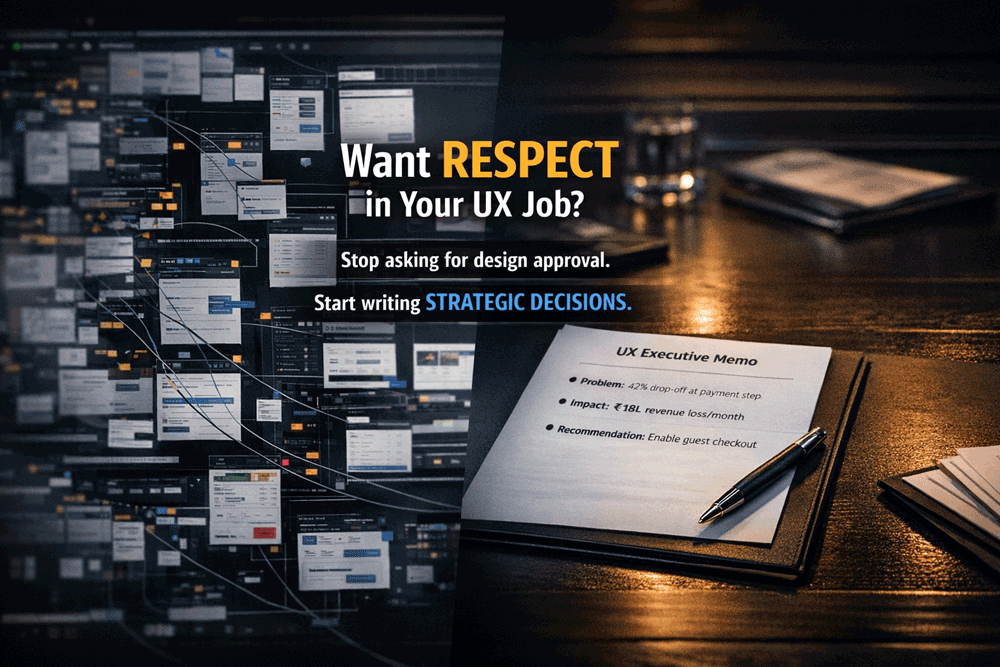
If you want respect in your UX job, stop asking for design approval and start writing strategic decisions. Senior UX influence comes from trust leadership-the intersection of ethics and clarity. The fastest way to signal this to executives? A weekly, ROI-focused UX memo your manager can forward directly to the C-suite.
Let me be direct. You don’t get stuck in a UX job because of a lack of Figma skills. You get stuck because your work doesn’t translate into business language.
I see this every week. Designers with years of experience under their belt. Solid user flows. Clean interfaces. But zero leadership signal. They sit down with me and ask, “Why am I not getting promoted?” or “Why am I facing this experienced ux no job offer market?”
Here is the harsh reality: Your case studies lack outcomes and accountability. You talk about empathy and component libraries, but leadership cares about revenue, retention, and risk. Nothing is wrong with your design skillset. What is missing is trust leadership.
I am Vaibhav Mishra, CTO and Co-founder of UXGen Studio and UXGen Academy. Throughout my career diagnosing complex friction points and hiring elite talent, I can tell you that trust is not built through design files. It is built through decisions, clarity, and written thinking.
Here is how you bridge that gap.
What is Trust Leadership in UX?
Trust leadership = Ethics + Clarity.
It is not about aesthetics or the latest trends. Trust leadership means you actively reduce ambiguity, highlight risks early, and connect your UX decisions directly to the company’s bottom line. Senior designers don’t ask for approval; they shape decisions.
A well-crafted UX memo does five things instantly:
-
Makes your thinking visible: Leadership doesn’t open design files; they read documents.
-
Reduces decision fatigue: You aren’t asking, “What should we do?” You are stating, “Here is what we should do, and here is the financial impact.”
-
Builds executive trust: Strategic clarity equals executive confidence.
-
Positions you beyond execution: You transition from a “resource” to a business decision partner.
-
Creates proof for promotions: You finally have a track record of measurable outcomes.
The 6 Weekly UX Memos Framework
This is not theory. This is what senior UX leaders do silently to command the room. Rotate through these six memos to change your career trajectory.
1. The Friction & Revenue Memo
Goal: Identify where users struggle and what it costs the business.
Don’t just show a new screen. Show the friction you removed and the pipeline you recovered.
-
Problem: 42% abandonment at the payment step.
-
Evidence: Analytics drop-off and session recording data.
-
Impact: Estimated $40k/month revenue loss.
-
Recommendation: Heuristic fix to form validation to recover 2% of the drop-off.
2. The Clarity & Retention Memo
Goal: Remove product confusion to reduce support loads.
Confusion equals hesitation, and hesitation equals lost conversions.
-
Focus: Fixing labels, broken flows, and messaging gaps.
-
Outcome: “We simplified the password reset flow. Monitoring for a 15% reduction in related customer support tickets this week.”
3. The Trust & Risk Memo
Goal: Prevent future damage through ethical design.
Senior designers don’t just solve problems; they mitigate risk. This is where ethics meets UX.
-
Focus: Highlighting UX debt, accessibility risks, and dark patterns.
-
Outcome: “Current hidden fees in the checkout are eroding trust and increasing chargebacks. Here is the transparent redesign that protects our brand reputation.”
4. The Experiment (CRO) Memo
Goal: Prove that your UX decisions are measurable.
Connect your work directly to Conversion Rate Optimization (CRO).
-
Structure: State your hypothesis, the design variant, the core metric, and the expected business impact (e.g., “Simplified onboarding → +20% user activation”).
5. The Strategic Decision Memo
Goal: Act like a product leader by presenting trade-offs.
Instead of asking what to do, present the data.
-
Structure: Detail the options considered, the engineering or timeline trade-offs, and your final, data-backed recommendation.
6. The Executive Outcome Scorecard
Goal: Document your accountability.
This is the memo that fixes the fact that your case studies lack outcomes and accountability. Send a monthly roll-up of your impact.
| UX Initiative | Primary Friction | Business Impact (Expected/Actual) | Status |
|---|---|---|---|
| Checkout Drop-off | High interaction cost | +3.5% Mobile Conversion Rate | Shipped |
| Dashboard Nav | High cognitive load | -12% Support tickets | Testing |
| Onboarding Flow | Trust deficit | +18% Activation Rate | Design Phase |
The Real Career Shift: UXGen Academy
At UXGen Academy, we don’t just train designers to push pixels. We build UX decision leaders.
If you are stuck in the mid-level trap, our AI Driven UX Mastery program is designed specifically for you. We strip away the outdated theory and tool obsession, focusing entirely on real product problems, real business metrics, and real decision frameworks.
I deploy my extensive industry experience directly into this curriculum. You will learn how to write these memos, leverage AI to speed up rigorous usability audits, and connect your UX work to revenue. It is fully job-oriented because companies today don’t need more designers – they need decision-makers.
Internal Resources to Deepen Your Expertise
To start shifting your mindset today, explore these resources:
Your Next Step
If you want respect, stop waiting for approval and start writing clarity. The person who defines the problem owns the room.
Don’t just read this and move on. Download The 6 UX Memos Executive Template (PDF) today. Use it for the next 30 days and watch how leadership responds to you. If you are serious about moving beyond execution and securing premium roles, DM me the word MASTERY.
FAQ: UX Leadership, Jobs & Growth
1. Why am I stuck in a UX job despite having experience?
Because experience without demonstrated business impact does not create value for executives. If your work doesn’t show measurable outcomes, leadership will not trust you with strategic decisions.
2. What does the “experienced ux no job offer” trend really mean?
It means the current market does not see strategic, executive value in your profile. Most senior portfolios still just show screens and standard processes, rather than business impact and ROI.
3. How can UX designers actually influence senior leadership?
By communicating clearly, reducing business ambiguity, and explicitly linking every UX decision to revenue generation, user retention, or risk mitigation.
4. What exactly should I add to my UX case studies to stand out?
You must add the core business problem, the metrics tracked, the strategic decisions taken (and why), and the actual financial or retention outcomes achieved. Remove the over-focus on visual aesthetics and generic empathy maps.
5. Are UX memos really that powerful for career growth?
Yes. Executives consume written documents and data, not design files. Memos make your strategic thinking visible, transferable, and defensible. That is exactly what leadership values and promotes.
6. How does UXGen Academy help with real UX job growth?
We focus on the intersection of UX and business. Instead of just teaching tools, I teach real-world decision-making, CRO thinking, and executive communication, positioning you as a high-value partner rather than a replaceable resource.


